Mahjong Solitaire
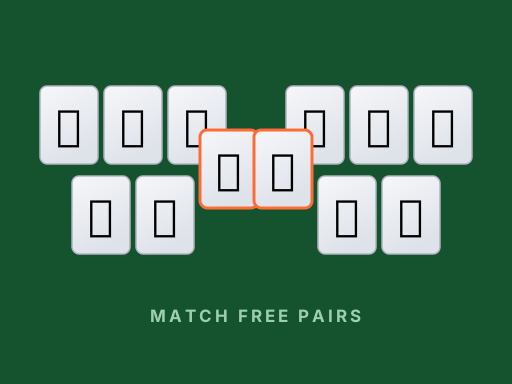
Clear a 144-tile pyramid by matching free pairs of identical mahjong tiles.
Mahjong Solitaire · Mahjong
🎮You May Also Like




About Mahjong Solitaire
Mahjong Solitaire is a tile-matching puzzle played with a mahjong set, and despite the name it has almost nothing to do with the four-player game. All 144 tiles are stacked into a layered pyramid. You remove them two at a time by finding matching pairs — but only tiles that are free can be taken.
A tile is free when nothing rests on top of it and at least one of its left or right edges is clear. That single rule is what turns a matching game into a planning game: the pair you can see is often not the pair you should take, because removing it can bury something underneath.
Every board here is generated to be solvable. Tiles are dealt in reverse — the game repeatedly picks two currently-free positions and assigns them the same face — so a complete solution is guaranteed to exist when you start. Reaching it is another matter, which is what Shuffle is for.
How to Play Mahjong Solitaire
- Tap a free tile to pick it up, then tap a matching one to remove the pair. Blocked tiles are dimmed and cannot be selected.
- A tile is free when no tile sits on top of it and either its left or right side is open. A tile with neighbours on both sides is locked even if nothing is above it.
- The counter at the top left shows tiles remaining. Clear all 144 to finish.
- If no free pair remains, use Shuffle. It keeps your progress and rearranges the remaining tiles into an arrangement that is solvable again.
- Your best clearing time is stored in your browser.
Controls
Tap or click a tile to select it, then tap its match. Tapping the selected tile again deselects it, and tapping a different free tile switches your selection rather than failing silently.
Hint outlines one available pair in green. Undo puts back the last pair you removed and can be used repeatedly. Shuffle redistributes the faces of the remaining tiles across their current positions — it is not a reset, your cleared tiles stay cleared, and the result is always solvable again.
There are no keyboard controls. On a phone the pyramid scales down and the layer offsets are preserved, so you can still see which tiles are stacked.
Tips and Tricks
- Clear the top layers first. Every tile you take off the upper levels frees several beneath it. Working the outer edges feels productive but opens far less.
- Check all four copies before matching. Each face appears four times. If three are free and one is buried, take the pair that leaves the buried one a partner.
- Watch the long rows. Tiles in the middle of a long row are locked on both sides, so start from an end and work inward.
- Do not match on autopilot. The first available pair is often the worst one — removing it can leave two identical tiles stacked on top of each other, which can never be matched.
- Use Shuffle without guilt. Dead ends are inherent to the format, not a sign you played badly. Shuffle exists so a good run is not thrown away.
Frequently Asked Questions
When is a tile free?
When nothing is stacked on top of it and either its left or its right edge is unblocked. A tile hemmed in on both sides is locked even with nothing above it.
Is every board solvable?
Yes at the start. Boards are built by dealing pairs into free positions in reverse, which guarantees a full solution exists. Your own move order can still create a dead end — that is what Shuffle is for.
What does Shuffle do?
It keeps every tile you have already removed and rearranges the faces of the remaining tiles among their current positions, producing a board that is solvable again.
How many tiles are there?
144 — the standard mahjong set: characters, bamboo and circles one to nine in fours, plus winds and dragons.
Is this the same as the four-player game?
No. It uses the same tiles but is a single-player matching puzzle. There is no scoring, no hands and no other players.
Last updated 2026-09-08 · More Mahjong games