Memory Match
Flip cards two at a time and find every matching pair in as few moves as you can.
Memory Match · Casual
🎮You May Also Like

About Memory Match
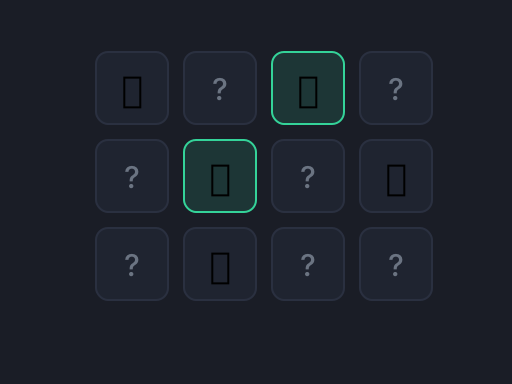
Memory Match is the card game most people know as Concentration or Pairs. All cards start face down. You turn over two at a time; if they show the same picture they stay up, and if they do not they flip back after a moment. Clear the whole board and you win.
Nothing about it is difficult to understand, which is what makes it a good test. The only thing standing between you and a perfect score is how much of the board you actually remembered while you were busy looking for something else.
Three sizes are available: 4×4 with 8 pairs for a quick round, 4×5 with 10 pairs, and 6×6 with 18 pairs where holding the board in your head genuinely stops being easy. Moves and elapsed time are both tracked, and your best result is stored separately for each size.
How to Play Memory Match
- Choose a board size. The timer starts on your first flip, not when the board appears — take as long as you like to get comfortable.
- Tap a card to turn it face up, then tap a second one. That counts as one move.
- If the two match, both stay face up with a green border and the pair counter goes up. If not, both flip back after about seven tenths of a second — long enough to register, short enough not to drag.
- Find every pair to finish. Your result is scored on moves first and time second.
- A perfect game uses exactly as many moves as there are pairs. That is essentially impossible on 6×6, which is rather the point.
Controls
One control: click or tap a face-down card. Matched cards are disabled and cannot be flipped again, and inputs are ignored during the brief window when two unmatched cards are showing — so you cannot accidentally lose your place by tapping ahead.
There are no keyboard shortcuts. The board scales to fit your screen, so the 6×6 grid stays comfortably tappable on a phone.
Tips and Tricks
- Work in a fixed order rather than tapping around. Sweeping left to right, top to bottom, builds a mental map with positions attached. Random tapping gives you pictures with no addresses.
- Say the position, not the picture. Remembering “banana, second row, third along” sticks far better than remembering that you saw a banana somewhere.
- When you flip something new, check it against your memory before flipping the second card. Most wasted moves come from turning over two cards you have never seen when you already knew where one of them was.
- Take the known pair immediately. Holding a match in reserve to “keep exploring” is how you forget it.
- On 6×6, work the corners first. Edge and corner positions are easier to encode than the middle, and it gives your map anchors.
Frequently Asked Questions
How many pairs are on each board?
4x4 has 8 pairs, 4x5 has 10 pairs, and 6x6 has 18 pairs. The card layout is shuffled fresh every game.
Is Memory Match good for kids?
Yes. There is no timer pressure, no way to lose, and the 4x4 board is a comfortable size for young children. The pictures are simple fruit icons.
How is my best score decided?
By moves first, then time as the tiebreaker. Your best is stored per board size in your browser.
What counts as a move?
Every pair of cards you turn over counts as one move, whether or not they match. Flipping the first card of a pair does not count on its own.
What is a perfect score?
Matching every pair on the first attempt — 8 moves on the 4x4 board, 18 on the 6x6. It requires flawless recall and a very lucky opening.
Last updated 2026-09-08 · More Casual games